
A Good Skincare Routine for Combination Skin: The 2026 Balance Guide
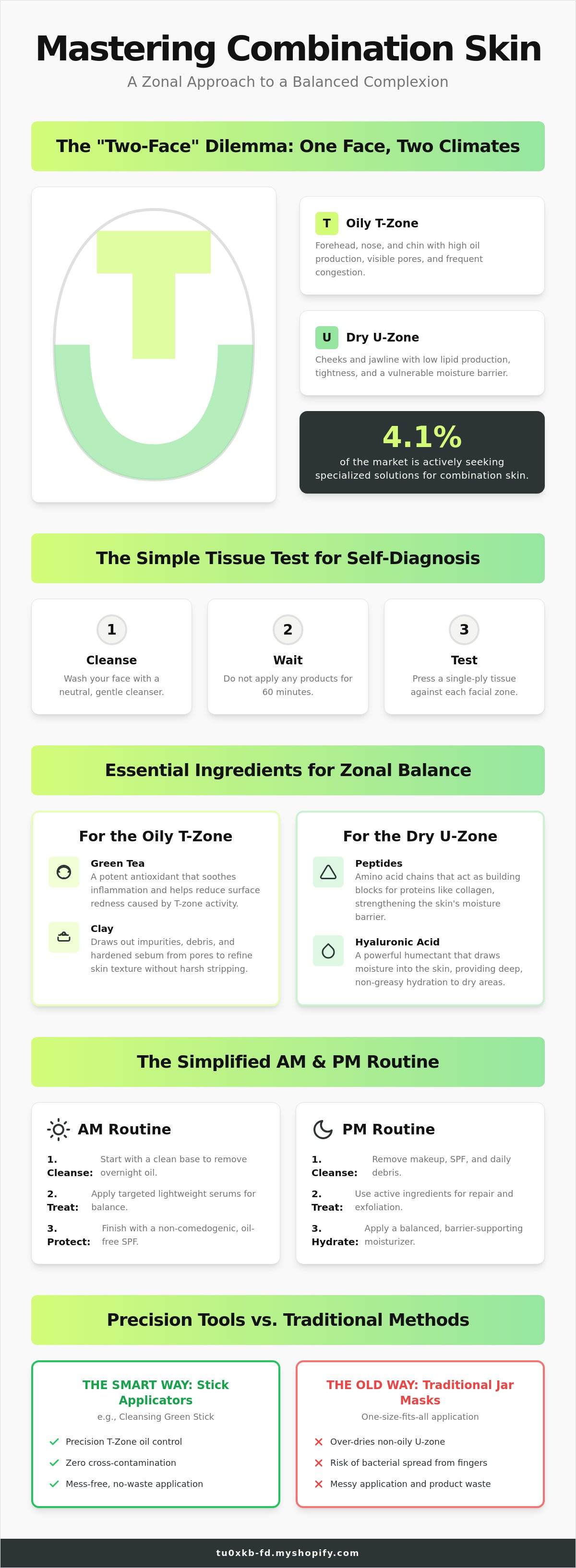
Why are you treating your face like one single climate zone? Most people with combination skin struggle with a greasy forehead and dry, tight cheeks. You're likely part of the 4.1% of the market currently seeking specialized solutions. Finding a good skincare routine for combination skin often feels like an expensive experiment. It ends in wasted products and clogged pores. Stop using one-size-fits-all formulas that only solve half the problem while ignoring the rest.
Achieving balance requires a functional approach to zonal management. You need to regulate sebum in the T-zone while hydrating the outer edges of your face. This guide provides a practical, step-by-step routine to master this balance. You'll learn how to stabilize your skin barrier, clear your pores, and maintain hydration without the grease. We'll preview essential 2026 tools, including the Cleansing Green Stick for targeted T-zone care and the AUQUEST Polypeptide Eye Serum Cream for efficient under-eye maintenance.
Key Takeaways
- Differentiate between high-sebum T-zones and moisture-depleted U-zones to apply the correct treatment to each specific area.
- Identify non-comedogenic "smart ingredients" that provide essential hydration without clogging pores or increasing surface oil.
- Master a good skincare routine for combination skin with a simplified AM and PM structure focused on cleansing, treating, and protecting.
- Swap traditional jar masks for targeted stick formats to manage oil production and dry patches with zero cross-contamination.
- Optimize your makeup canvas by using precision tools and balanced skin prep to ensure long-lasting, even coverage across all zones.
Identifying Combination Skin: The T-Zone vs. U-Zone Conflict
Combination skin is a physiological state where different facial regions exhibit opposing characteristics. It's defined by the presence of both overactive oil production and localized dehydration. Most individuals experience this as the "Two-Face" dilemma. Applying products designed for oily skin across the entire face often damages the dry areas, leading to irritation and flaking. Conversely, heavy emollients intended for dry cheeks can trigger breakouts in the T-zone. Establishing a good skincare routine for combination skin requires understanding these distinct micro-climates and applying targeted treatments.
The T-zone includes the forehead, nose, and chin: areas characterized by high sebaceous gland density, visible pores, and frequent congestion. In contrast, the U-zone consists of the cheeks and jawline: regions defined by lower lipid production, potential flaking, and a vulnerable moisture barrier. Effective management relies on foundational skin care principles that prioritize balance over universal treatment. Treating these zones as separate environments is the only way to achieve a clear, hydrated complexion without secondary irritation.
The Sebum Disparity: Why Your Face Acts Differently
Genetics and hormones primarily dictate how much oil your glands produce. Testosterone levels and menstrual cycles frequently cause spikes in T-zone activity. Environmental factors like high humidity also stimulate oil production more aggressively in the T-zone than on the cheeks. Sebum is the body’s natural oil that protects the skin barrier. While essential for health, an excess leads to the visible shine and enlarged pores characteristic of the T-zone. This disparity makes a good skincare routine for combination skin difficult to maintain without specialized tools like the Cleansing Green Stick, which targets high-sebum areas without stripping the surrounding skin.
The Simple Tissue Test for Self-Diagnosis
Self-diagnosis is the first step toward effective balance. Follow this 3-step tissue test for accuracy:
- Step 1: Wash your face with a neutral, gentle cleanser to remove all surface debris.
- Step 2: Wait 60 minutes without applying any serums, moisturizers, or treatments.
- Step 3: Press a single ply of tissue against your forehead, nose, and cheeks.
If the tissue shows oil from the T-zone but remains dry on the cheeks, you have combination skin. Look for mid-day shine in the center of your face while feeling tightness or seeing fine lines on your jawline. Your skin type can shift over time. Aging typically reduces overall oil production, while summer humidity often increases T-zone congestion. Monitoring these shifts allows you to adjust your product application for consistent results.
Essential Ingredients for Balancing Moisture and Oil
Effective ingredient selection is the foundation of a good skincare routine for combination skin. You must prioritize "smart ingredients" that provide localized benefits without disrupting the entire facial ecosystem. This involves using non-comedogenic formulas that prevent T-zone congestion while delivering deep hydration to the U-zone. High-performance routines avoid heavy occlusives that sit on the surface. Instead, they utilize lightweight humectants and targeted botanical extracts to maintain a matte center and supple cheeks.
Building a balanced AM and PM routine requires selecting ingredients that perform specific functions without causing secondary issues. For the oily regions, focus on sebum-regulating compounds. For dry areas, prioritize barrier-repairing lipids. This dual-action approach ensures your skin remains hydrated but never greasy.
Green Tea and Clay for Targeted Oil Control
Green tea is a potent antioxidant that actively soothes inflammation in the T-zone. It helps reduce surface redness and neutralizes environmental stressors that trigger excess oil production. When combined with clay, these ingredients create a powerful purification system. Clay particles draw out impurities, debris, and hardened sebum from deep within the pores. This process refines skin texture without the aggressive stripping associated with alcohol-based toners.
Application method matters as much as the ingredient itself. Using a Cleansing Green Stick allows for mess-free, precise application. You can apply the clay-based formula specifically to the forehead and nose while leaving the drier cheeks untouched. This targeted strategy prevents the "over-drying" effect common with traditional jar masks. It’s an efficient way to manage oil production on a daily basis.
Peptides and Hyaluronic Acid for Deep Hydration
The U-zone requires humectants like hyaluronic acid to lock in water at the cellular level. Hyaluronic acid attracts up to 1,000 times its weight in water, providing essential volume to dry cheeks without adding weight. Peptides complement this by maintaining skin elasticity and repairing the delicate skin barrier. These amino acid chains signal the skin to produce more collagen, which is critical for areas prone to premature fine lines.
Specialized care is necessary for the under-eye area, where the skin is thinnest and most vulnerable. Peptides are crucial here to address dark circles and puffiness without clogging the surrounding pores. You can find detailed instructions on optimizing this step in our Polypeptide Eye Serum Guide. For a streamlined experience, consider the AUQUEST Polypeptide Eye Serum Cream to provide targeted repair during your evening routine.
Strategic Product Selection: Sticks, Serums, and Tools
Selecting the right delivery format is as critical as the ingredients themselves. A good skincare routine for combination skin relies on precision application to ensure every zone receives exactly what it needs. Traditional jar masks often fail this skin type. They are difficult to apply to specific areas and prone to bacterial contamination from repeated finger contact. Modern stick formats and targeted serums solve these issues by allowing for "zonal management." This approach ensures you aren't applying oil-absorbing clays to dry cheeks or heavy occlusive creams to a congested forehead.
Serums are superior to heavy creams for the T-zone due to their molecular structure. Creams often contain thick waxes and oils that sit on the surface, trapping sebum and leading to breakouts. Serums utilize water-based delivery systems to transport active ingredients directly into the pores without adding weight. By integrating precision tools like rollers and brushes, you can maintain a balanced complexion with minimal product waste and maximum hygiene.
The Stick Revolution: Precise T-Zone Management
Stick masks represent a significant shift in how we manage combination skin. These solid formulas allow for direct application only where needed. You can trace the exact lines of your T-zone without touching the drier U-zone. This precision prevents the accidental dehydration of your cheeks while you treat a shiny forehead. The Cleansing Green Stick utilizes a twist-up applicator to provide a mess-free experience that traditional clay masks cannot match.
Hygiene is a primary benefit of the stick format. You never have to touch the product with your hands, which reduces the risk of transferring bacteria to your face. To use a green tea stick effectively, glide it over the nose and forehead immediately after cleansing. Let the formula sit for ten minutes before rinsing. This targeted application ensures the clay draws out impurities from high-sebum areas while leaving your moisture-prone cheeks undisturbed. It is a streamlined, functional solution for daily oil control.
Serum Rollers: Maximizing Under-Eye Absorption
The under-eye area requires specialized tools to handle its unique thinness and sensitivity. A rollerball applicator provides a cooling sensation that immediately helps reduce morning puffiness and vasoconstriction. This mechanical action works in tandem with the formula to improve lymphatic drainage. Rollers distribute a polypeptide eye serum evenly across the skin, preventing the tugging or pulling associated with manual finger application.
Precision is the key to under-eye repair. Using the AUQUEST Polypeptide Eye Serum Cream ensures that concentrated peptides reach the skin without migrating into the pores of the cheeks where they aren't needed. For enhanced results, keep your serum rollers in the fridge. The cold temperature increases the depuffing effect and provides a professional-grade treatment at home. This simple adjustment to your routine maximizes the efficiency of your products and ensures your skin remains hydrated and firm without irritation.
Step-by-Step: The Balanced AM and PM Routine
Establishing a good skincare routine for combination skin relies on the "Cleanse, Treat, Protect" framework. Consistency is more valuable than a high product count. A minimal routine performed daily yields better results than an irregular, complex one. Your skin's needs will fluctuate with the seasons. During high-humidity summer months, focus on lightweight layers and oil management. In dry winter conditions, prioritize barrier-repairing lipids for the U-zone. Broad-spectrum SPF is non-negotiable for all facial areas to prevent UV damage and premature aging.
A good skincare routine for combination skin requires different intensities for different zones. You don't need a dozen products. You need the right application of core essentials. By treating the T-zone and U-zone as separate environments, you avoid the common pitfalls of over-drying or over-moisturizing. This methodical approach ensures long-term skin health and a balanced complexion.
The Morning Routine: Protection and Shine Control
Morning care focuses on environmental protection and shine management. Follow these four steps to prep your skin for the day:
- Step 1: Use a gentle pH-balanced cleanser. This removes sebum accumulated during sleep without disrupting the moisture barrier on your cheeks. Maintaining the acid mantle prevents the "rebound" oil production that occurs when skin is over-stripped.
- Step 2: Apply a lightweight antioxidant serum to the entire face. Ingredients like niacinamide help protect against oxidative stress and brighten the complexion.
- Step 3: Use an oil-free moisturizer specifically on the U-zone. If your T-zone is particularly oily, skip the moisturizer there or use a very thin layer.
- Step 4: Apply broad-spectrum SPF using the "dotting" method. Distribute small amounts across all zones before blending. This ensures even coverage without the heavy, greasy feeling of a single large application.
The Evening Routine: Repair and Deep Cleansing
Evening care shifts toward deep cleansing and cellular repair. This is the time to address localized issues with precision:
- Step 1: Perform a double cleanse. Start with a cleansing balm to break down long-wear makeup and mineral sunscreens. Follow with a water-based cleanser to remove residual debris. This prevents pore congestion in the T-zone.
- Step 2: Integrate a targeted treatment. Apply the Cleansing Green Stick to the forehead, nose, and chin two to three times per week. This draws out impurities without affecting the drier regions of your face.
- Step 3: Apply AUQUEST Polypeptide Eye Serum Cream. Use the built-in rollerball to massage the formula into the under-eye area. This improves absorption and reduces mechanical stress on the skin.
- Step 4: Finish with a nourishing night cream. Apply the product primarily to the cheeks and jawline. The U-zone requires these richer emollients to recover from daily environmental exposure.
Optimize your evening routine and buy the AUQUEST Polypeptide Eye Serum Cream for targeted under-eye repair.
Precision Maintenance and Makeup Integration
Balanced skin is the prerequisite for successful makeup application. Without a good skincare routine for combination skin, foundation often separates on the oily T-zone or clings to dry patches on the cheeks. Proper preparation creates a uniform surface tension across different facial environments. This prevents the common issue of makeup sliding off the nose by mid-afternoon. Zonal management ensures that your cosmetics adhere correctly to both the lipid-rich center and the moisture-depleted perimeter of your face. A well-maintained canvas requires fewer corrective products and less frequent touch-ups throughout the day.
Establishing a good skincare routine for combination skin simplifies your beauty regimen. When the skin's natural oil production is regulated, you don't need heavy primers to mask texture or intense mattifiers to control shine. You can focus on enhancing features rather than hiding imbalances. Long-term skin health is achieved by treating your face as a collection of distinct micro-climates that each require specific, functional care.
Prepping the Canvas for Precision Makeup
Precision tools are essential for achieving sharp, professional results on balanced skin. When your skin barrier is healthy and surface texture is refined, application becomes more predictable. Utilize a blade eyeliner brush to create crisp, thin lines that won't smudge against prepped eyelids. For those struggling with symmetry, a seal eyeliner pen provides a structured stamp for consistent winged looks. To maintain this finish, apply translucent powder only to the T-zone. This absorbs excess sebum without dulling the natural radiance of your cheeks.
Long-Term Maintenance: When to Adjust Your Routine
Consistency is the goal, but your skin is a dynamic organ. Environmental changes, hormonal shifts, and aging require periodic adjustments to your product selection. Sudden tightness in the U-zone or new congestion in the T-zone indicates an imbalance in your current approach. During flare-ups, adopt a "less is more" strategy. Strip your routine back to a basic cleanser and moisturizer to allow the skin barrier to stabilize before reintroducing active treatments.
Conduct a monthly "skin audit" to verify the efficacy of your products. Check for persistent shine, flaking, or sensitivity. If your T-zone remains greasy despite using the Cleansing Green Stick, you may need to increase application frequency to three times per week. Conversely, if cheeks feel rough, integrate a richer night cream into your PM steps. Regular assessment ensures your routine remains functional and responsive to your skin's evolving needs. This proactive maintenance prevents minor imbalances from becoming chronic concerns.
Achieving Long-Term Facial Balance
Maintaining a good skincare routine for combination skin depends on consistent zonal management. You now understand how to treat the oily T-zone and dry U-zone as two distinct environments. Success requires using targeted ingredients like green tea for oil regulation and peptides for moisture retention. Precision tools like stick masks and serum rollers eliminate the mess and cross-contamination common with traditional jar products. These functional beauty essentials offer direct-to-consumer value by prioritizing ingredient efficacy over decorative packaging.
By focusing on tangible results and practical application, you can stabilize your skin barrier and clear your pores effectively. Transitioning to a routine that respects your skin's specific micro-climates prevents the cycle of over-drying and breakouts. It's time to stop guessing and start using tools designed for balance. Your skin's health is a long-term investment that pays off in clarity and comfort.
Shop the Nebulux Skincare Collection for Combination Skin to access targeted stick and roller formats. Start your journey toward a balanced, clear complexion today.
Frequently Asked Questions
How do I know if I have combination skin?
You have combination skin if your forehead, nose, and chin produce excess oil while your cheeks feel dry or tight. Perform a tissue test 60 minutes after cleansing. If the tissue shows oil only from the T-zone, you're among the population managing this specific skin type. It's a common condition requiring a good skincare routine for combination skin to maintain facial equilibrium.
Can I use two different moisturizers for combination skin?
Using two moisturizers is an effective strategy for zonal management. Apply a water-based gel to the oily T-zone to prevent pore congestion. Use a richer emollient cream on the U-zone to repair the moisture barrier and prevent flaking. This dual-product approach ensures each region receives the appropriate lipid concentration without causing breakouts or secondary irritation.
How often should I use a clay mask on combination skin?
Use a clay mask two to three times per week, focusing exclusively on the oily regions. Applying clay to dry cheeks can cause redness and flaking. A Cleansing Green Stick allows for precise application to the nose and forehead without touching sensitive areas. This frequency effectively regulates sebum production while maintaining the health of your moisture-prone U-zone.
Is a foaming cleanser good for combination skin?
Foaming cleansers are suitable if they utilize gentle surfactants and maintain a neutral pH. These formulas effectively remove surface sebum from the T-zone without stripping the cheeks. Avoid cleansers with high alcohol content or aggressive sulfates. A balanced foam ensures a clean canvas for the rest of your products while protecting the delicate skin barrier from dehydration.
Why is my T-zone oily but my cheeks are flaky?
This disparity occurs because sebaceous gland density is significantly higher in the center of the face. Your T-zone produces more sebum due to genetic and hormonal factors. Meanwhile, the U-zone has fewer glands and is more susceptible to environmental moisture loss. A good skincare routine for combination skin addresses this conflict by balancing hydration and oil control simultaneously.
Can I use face oil if I have combination skin?
You can use face oils if you select non-comedogenic varieties like squalane or jojoba oil. Apply these oils only to the dry U-zone to lock in moisture and soothe flaking. Avoid applying oils to the T-zone, as this can lead to clogged pores and increased shine. Stick to lightweight, water-based serums for the central regions of your face to avoid congestion.
How do I stop my makeup from separating on my nose?
Makeup separation on the nose is usually caused by excess oil breaking down the cosmetic formula. Control this by using a clay stick to clear pores before application. Use a thin layer of oil-free moisturizer and set the area with a translucent powder. These steps provide a stable surface and prevent the "sliding" effect common in high-sebum zones.
What is the best way to apply eye serum for combination skin?
The most effective method is using a cooling rollerball applicator for targeted delivery. This ensures the formula penetrates the thin under-eye skin without migrating to other zones. The AUQUEST Polypeptide Eye Serum Cream features a roller that improves lymphatic drainage and reduces morning puffiness. Apply in a gentle outward motion to maximize absorption and minimize mechanical stress on the skin.