
Blade Eyeliner Brush: Technical Specifications and Precision Application Guide
The standard angled brush is the primary cause of inconsistent wing thickness and splaying fibers. It lacks the specific geometry required for the sharp, structural lines seen in the 2026 "Revenge Eyeliner" trend. A professional blade eyeliner brush utilizes a thinner, more rigid profile to mimic microblading accuracy with standard gel or liquid products.
It's frustrating when standard tools fail to produce the crisp, micro-fine strokes needed for modern graphic looks. You need a tool that offers reliability and long-lasting performance. This article helps you master the mechanics of ultra-thin eyeliner application through a technical analysis of the blade brush design and professional usage techniques.
This overview covers synthetic fiber construction, ferrule stability, and multi-use applications for eyes and brows. You'll gain the technical knowledge required for professional-grade symmetry and precision.
Key Takeaways
- Identify the ultra-thin, flat-angled geometry required for sharp edges and structural line precision.
- Evaluate the structural integrity of the blade eyeliner brush compared to standard angled profiles for reduced fiber splaying.
- Master the "Stamp and Drag" application method for symmetric wings and controlled line thickness.
- Follow specific cleaning protocols for synthetic brushes to prevent product buildup and maintain long-term edge sharpness.
- Access professional-grade specifications and direct-to-consumer value with the Nebulux precision tool kit.
Understanding the Blade Eyeliner Brush Design and Geometry
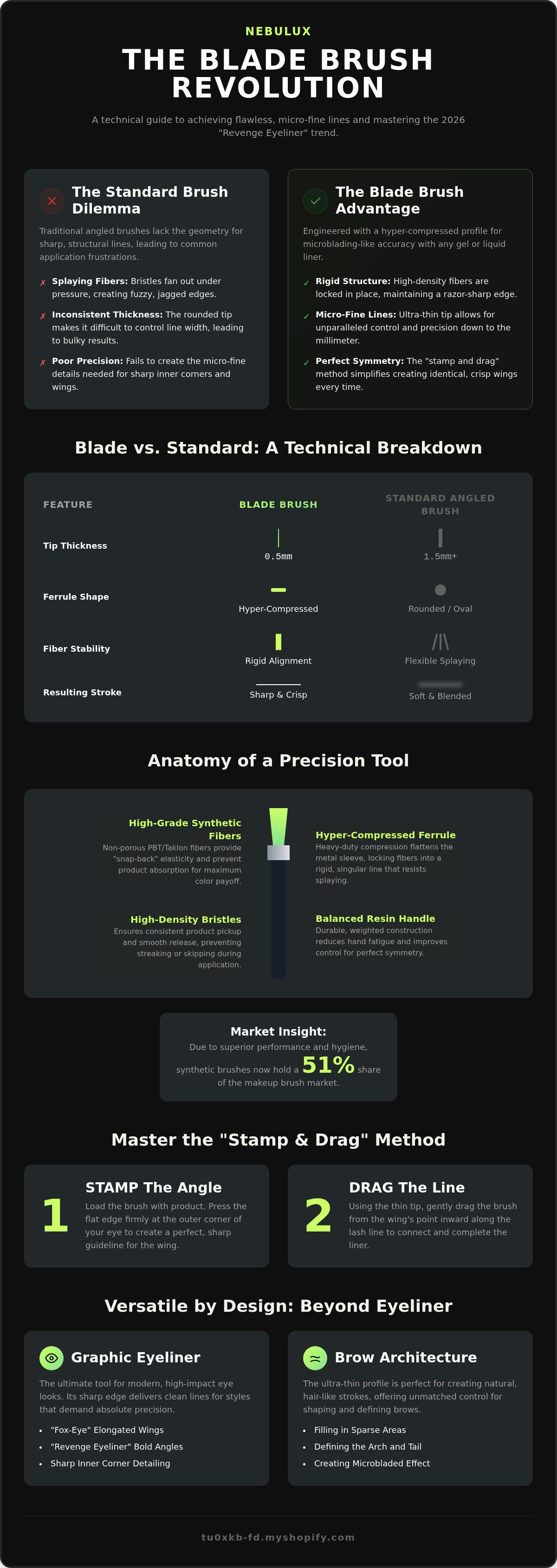
A blade eyeliner brush is a high-precision tool defined by its ultra-thin, flat-angled head. It represents a technical evolution from the traditional angled brush. While standard brushes often feature a rounded or oval ferrule, the blade profile utilizes extreme vertical compression. This engineering choice creates a razor-sharp edge capable of producing micro-fine lines. The term "blade" refers specifically to the millimeter thickness of the ferrule rather than the angle of the cut. This specialized geometry allows for the sharp inner corners and extended wings required by 2026 "Revenge Eyeliner" trends. It translates professional microblading accuracy into a consumer-friendly accessory. The transition from standard tools to this specialized profile is driven by the demand for graphic, sculpted looks that require absolute edge control.
The Anatomy of a Precision Beauty Tool
Every component of the tool serves a functional purpose. The ferrule construction is the most critical element. Manufacturers use heavy-duty compression to flatten the metal sleeve. This forces the bristles into a rigid, singular line that resists splaying. Precision depends on the relationship between the ferrule and the bristles. The compression ratio determines how well the brush holds its shape under pressure. In a standard brush, the fibers have room to move. In a blade eyeliner brush, the fibers are locked into a fixed position. The handle is typically constructed from treated wood or high-density resin. These materials provide the necessary durability for daily professional use. A well-balanced tool reduces hand fatigue and improves the symmetry of the final look. Fiber density is also optimized. A high-density bristle count ensures consistent product pickup and smooth release. This prevents the streaking or "skipping" often associated with lower-quality tools.
Synthetic Fiber Engineering in Modern Brushes
Modern professional tools favor high-grade synthetic fibers like PBT or Taklon over natural hair. These materials are non-porous. They won't absorb liquid or gel products. This ensures that the eyeliner stays on the surface of the bristles for maximum color payoff. Synthetic bristles provide the "snap-back" elasticity required for creating sharp, structural wings. They maintain their shape even after repeated use with heavy gel formulas. Hygiene is a secondary but vital benefit. Synthetic materials are easier to clean and dry faster. They're less likely to harbor bacteria, making them safer for use in the sensitive eye area. The result is a durable, high-performance accessory that meets strict regulatory standards. Synthetic hair brushes now hold a dominant 51% share of the makeup brush market because they offer consistent performance across various product formulas.
Performance Comparison: Blade vs. Traditional Eyeliner Brushes
Standard angled brushes utilize a cylindrical or oval ferrule, resulting in a tip thickness that often ranges between 1.0mm and 2.5mm. This thickness is suitable for soft blending but lacks the definition required for graphic styles. A blade eyeliner brush is engineered with a hyper-compressed ferrule. This design reduces the edge thickness to approximately 0.5mm. This dimensional shift allows for a technical "stamp" application rather than a traditional painting stroke. The difference in results is immediate:
- Tip Thickness: 0.5mm (Blade) vs. 1.5mm+ (Standard)
- Ferrule Shape: Hyper-compressed flat vs. Rounded/Oval
- Stroke Type: Stamp and drag vs. Painting/Blending
- Fiber Stability: Rigid alignment vs. Flexible splaying
Structural integrity is the second major performance metric. Under pressure, traditional angled bristles tend to splay or "fan out," which creates a jagged edge and inconsistent product distribution. The blade design uses higher-density synthetic fibers locked into a rigid vertical alignment. This structural stability ensures the brush maintains its razor-thin profile even during high-pressure flick motions. Application speed improves through the "one-swipe" mechanic. Because the brush holds its shape, you don't need to go back over lines to clean up fuzzy edges. It delivers a clean, opaque line in a single movement.
Achieving Ultra-Thin Lines for the Fox-Eye Look
The fox-eye look demands an elongated, sharp wing and a defined inner canthus. Using a blade brush simplifies this process. The flat edge acts as a geometric template. You can stamp the initial wing angle with one press. This creates a perfect guide for the rest of the application. In the inner corner, the narrow profile fits comfortably into the tight space of the canthus. It allows for sharp, micro-fine detailing without the risk of product smudging onto the lid. You can layer product for intensity without adding unwanted bulk to the line width.
Multi-Purpose Utility: From Liner to Brows
This tool's utility extends to brow architecture. The 0.5mm edge is ideal for mimicking individual hair strokes in sparse areas. It provides the "flick" control needed to define the brow tail with surgical precision. It's also an effective tool for defining "cut crease" eyeshadow boundaries. The rigid edge carves out clean lines with cream or liquid pigments. For professionals requiring this level of technical versatility, the Nebulux blade eyeliner brush offers the precision and durability needed for high-stakes eye and brow work.
Professional Application Techniques for Symmetric Results
The "Stamp and Drag" method is the primary technique for achieving symmetry with a blade eyeliner brush. Instead of drawing a continuous line, place the flat edge of the brush against the outer corner of the eye. Press firmly to "stamp" the initial wing shape. Once the angle is established, drag the brush inward toward the lash line. This method uses the tool's geometry to ensure both wings match in angle and length. It eliminates the guesswork associated with freehand drawing.
Pressure adjustment is critical for line weight control. Light contact produces a 0.5mm micro-line. Increasing downward pressure spreads the fibers slightly, allowing for a thicker, more dramatic wing. The brush angle should remain consistent. Hold the tool at a 45-degree angle to the skin for the initial wing map. For the inner corner, rotate the brush so the tip points toward the nose. If an error occurs, use the clean edge of the brush to "carve" the liner into a sharper point. This "eraser" technique works best while the product is still damp.
Mapping the Perfect Winged Liner
Successful application starts with mapping. Align the edge of the brush with the natural upward curve of the lower lash line. This line serves as your trajectory. Use the brush handle as a straight-edge ruler to check symmetry between both eyes before applying product. Connect the highest point of the wing back to the upper lash line. This creates a seamless flow that lifts the eye area without creating a "disconnected" appearance. The rigid ferrule ensures the line stays straight during this transition.
Formula Compatibility: Gel, Liquid, and Powder
High-density synthetic fibers are optimized for gel formulas. Gel pots provide the necessary grip for the stamp technique. When using liquid liners, avoid dipping the brush directly into the bottle. Instead, dispense a small amount onto a palette. Load only the very edge of the blade eyeliner brush to prevent product from traveling up the ferrule. For a softer look, use a damp brush with powder eyeshadow. The moisture activates the pigment while the blade edge maintains the sharp boundary. This versatility makes the tool a kit essential for various aesthetic requirements.
Maintenance and Longevity of Fine Synthetic Brushes
Product buildup is the primary cause of lost precision. Residual gel or liquid pigment hardens between the fibers, causing the 0.5mm edge to thicken and splay. This accumulation prevents the blade eyeliner brush from delivering the sharp, micro-fine strokes required for graphic looks. Daily users must clean the tool after every application to maintain structural integrity. For occasional users, immediate cleaning prevents pigments from staining the high-grade synthetic fibers. Water direction during washing is critical for tool longevity. Always rinse with the brush head pointing downward. This prevents water from entering the ferrule and dissolving the internal adhesive. If the adhesive degrades, the fibers will shed, and the compressed blade shape will fail. After rinsing, gently squeeze the bristles between a clean towel to remove excess moisture. Reshape the edge into its razor-thin profile while the fibers are still damp to ensure it dries in the correct geometry.
Cleaning Fine-Point Synthetic Brushes
Choose your cleanser based on the product formula. Oil-based cleansers are required for waterproof gels and long-wear liquids. Water-based formulas suffice for powder pigments. Apply a small amount of cleanser to the palm. Use gentle, sweeping motions to break down the product. Avoid circular friction, as this can bend the fine fibers and permanently distort the edge. Proper maintenance ensures that the synthetic bristles maintain their non-porous nature and elasticity over hundreds of uses. For a comprehensive walkthrough on sanitization and buying considerations, refer to our guide on how to clean eyeliner brush techniques.
Storage and Fiber Protection
Storage environment directly impacts performance. Use protective caps to prevent splaying when the tool is stored in a makeup bag or kit. Horizontal storage is preferred over vertical storage. This orientation ensures no residual moisture seeps back into the ferrule during the drying process. This protects the wood or resin handle from swelling and cracking over time. Replace the tool when you identify permanent fiber fatigue. This occurs when the bristles no longer "snap back" to a singular edge after cleaning or when the tips feel scratchy against the skin. Maintaining a professional-grade kit requires high-quality replacements. You can source a retail-ready Nebulux blade eyeliner brush to ensure your tools meet current technical standards for precision eye makeup.
Why the Nebulux Blade Eyeliner Brush is a Kit Essential
The Nebulux blade eyeliner brush provides professional-grade specifications for consistent results. It bridges the gap between technical artistry requirements and consumer accessibility. Our direct-to-consumer focus ensures retail-ready quality without boutique markups. This tool is a priority SKU within our eye makeup tools collection. It's also recognized as a top choice for the best eyeliner brush for beginners due to its intuitive stamp-based geometry. The design prioritizes durability and long-term performance for daily users.
The Nebulux Quality Standard
Nebulux maintains a strict quality standard for every precision tool. The rigid ferrule design eliminates head wobbling during delicate strokes. This stability is critical for symmetric wing application. We utilize high-density vegan and cruelty-free synthetic fibers. These bristles offer the necessary snap-back elasticity for sharp, structural lines. The utilitarian aesthetic fits seamlessly into professional kits or home vanity setups. It's a grounded, no-nonsense tool that focuses on the tangible results of the application.
Completing Your Precision Eye Routine
Pairing the brush with compatible products maximizes its utility. Use it to refine the edges of the CmaaDU Seal Eyeliner for a professional, hybrid look. The fine tip is also effective for the targeted application of AUQUEST Polypeptide Eye Serum Cream to the under-eye area. This prevents product waste and ensures precise placement of active ingredients. Follow this final checklist for a professional eye makeup finish:
- Alignment: Match wing angles using the brush handle as a guide.
- Loading: Only apply product to the final 1mm of the tip to prevent bulk.
- Symmetry: Stamp both outer corners before dragging the line inward toward the lash line.
- Maintenance: Clean immediately after use to preserve the 0.5mm edge and prevent fiber splaying.
Our commitment to functional eye makeup tools ensures you have exactly what's needed for symmetric, long-lasting results. The Nebulux brush is a reliable digital storefront offering that values your time and application precision.
Upgrade Your Technical Precision
Professional eye makeup results depend on the specific geometry of your tools. A standard angled brush often fails where a blade eyeliner brush excels. The 0.5mm compressed edge provides the structural integrity needed for the 2026 "Revenge Eyeliner" trend and sharp brow architecture. You now have the technical breakdown of fiber density, ferrule compression, and the "stamp and drag" method required for absolute symmetry. This technical shift from generic tools to specialized accessories is the most efficient way to eliminate inconsistent wing thickness.
Our design utilizes precision-engineered synthetic fibers that resist splaying and product absorption. This multi-use tool serves as a reliable asset for both eyes and brows, maintaining its razor-sharp profile through hundreds of applications. We provide a direct-to-consumer experience focused on high-utility inventory and fast national shipping to ensure your kit remains retail-ready. It's time to replace outdated applicators with tools designed for modern accuracy.
Shop the Nebulux Blade Eyeliner Brush for Professional Precision
Start creating sharper, more symmetric wings today with the right technical foundation.
Frequently Asked Questions
What is a blade eyeliner brush used for?
A blade eyeliner brush is a specialized tool for creating ultra-thin, graphic eyeliner looks with surgical precision. It is used to apply gel, liquid, or powder pigments along the lash line and for extending sharp wings. The hyper-compressed ferrule allows for detailed work in the inner corners and creates structural lines that standard brushes cannot achieve.
Is a blade eyeliner brush better than a slanted brush?
It is superior for precision and edge control. Traditional slanted brushes typically feature a tip thickness between 1.0mm and 2.5mm, whereas a blade eyeliner brush is approximately 0.5mm thick. This thinner profile resists splaying under pressure, ensuring a cleaner line and more consistent product distribution during application.
Can I use a blade eyeliner brush for my eyebrows?
Yes, this tool is highly effective for brow architecture. The narrow edge allows you to mimic individual hair strokes to fill gaps or define a sharp brow tail with high accuracy. It provides a microblading-style finish when used with brow pomades, gels, or powders, making it a versatile kit essential.
How do I get a sharp wing with a blade brush?
Use the stamp and drag technique for the best results. Align the flat edge of the brush with the natural upward curve of your lower lash line to stamp the initial wing angle. Once established, drag the brush inward toward the upper lash line with light pressure to create a seamless, razor-sharp finish.
What is the best material for a blade eyeliner brush?
High-grade synthetic fibers like PBT or Taklon are the standard for this tool. These materials are non-porous, meaning they won't absorb liquid or gel products, which ensures maximum color payoff. Synthetic bristles also provide the "snap-back" elasticity required to maintain a sharp, structural edge over time.
How often should I wash my blade eyeliner brush?
Wash the brush after every use if you're applying gel or liquid formulas. Product buildup hardens the bristles and destroys the 0.5mm precision edge, leading to splaying. Regular cleaning with an oil-based cleanser for waterproof products preserves the tool's structural integrity and ensures hygienic application near the eye.
Can I use a blade brush with liquid eyeliner?
You can use it with liquid eyeliner by dispensing the product onto a palette first. Load only the final 1mm of the brush head to prevent the liquid from traveling up into the ferrule. This technique protects the internal adhesive and maintains the rigid vertical alignment of the synthetic fibers.
Does a blade eyeliner brush work for hooded eyes?
It is highly effective for hooded eyes because of its ultra-thin profile. The narrow edge allows you to apply liner extremely close to the lash line without consuming limited lid space. It is also the ideal tool for the "bat-wing" technique, ensuring the liner remains visible and sharp when the eye is open.