
How to Clean Eyeliner Brush: Maintenance and Buying Guide 2026
Did you know the average makeup brush contains nearly 11 million colony-forming units of bacteria? Research indicates these tools are often significantly dirtier than a public toilet seat. For precision instruments, this level of contamination is a performance killer. Understanding how to clean eyeliner brush tools is essential for both ocular health and makeup accuracy. If you've ever struggled with stubborn gel buildup or bristles that lose their shape after washing, you know the frustration of poor maintenance.
It's difficult to achieve a sharp wing when your tools are clogged with old product or contaminated with fungi. You want a routine that keeps brushes surgically clean while protecting the delicate bristle structure. This guide provides professional sanitization methods to ensure your application remains precise and bacteria-free. We'll outline the American Academy of Dermatology's cleaning standards, structural maintenance tips, and the essential hygiene tools for 2026 to keep your kit in peak condition.
- Hygiene and precision. Eliminates bacterial buildup. Ensures consistent sharp wing execution and ocular safety.
- Maintenance supplies. Utilization of gentle surfactants and isopropyl alcohol for effective synthetic fiber sterilization.
- Cleaning protocols. Professional methods for how to clean eyeliner brush tools using lukewarm water and specialized mats.
- Structural preservation. Drying and realignment techniques designed to maintain fine blade edges and prevent shedding.
- Tool selection. Focus on stain-resistant synthetic fibers and securely crimped, water-tight ferrules for long-term durability.
Why Regular Cleaning is Essential for Precision
Eyeliner application demands absolute precision. A single millimeter of deviation ruins a sharp wing or a tight line. When product accumulates, bristles lose their taper and flexibility. This buildup creates a physical barrier between the tool and the skin. Instead of a smooth glide, you experience dragging, skipping, and uneven lines. Learning how to clean eyeliner brush sets is the first step toward professional-grade results. Without a clear, sharp edge, even the most expensive pigments will appear clumpy and amateurish.
The Impact on Makeup Application
Residual gel and liquid formulas harden within the fiber matrix. This calcification forces bristles apart, destroying the fine point required for blade-style application. Clean bristles ensure even pigment distribution without clumping or streaking. Maintaining high-quality eye makeup tools requires removing these films before they bond to the fiber. Different Types of makeup brushes react differently to product saturation. Synthetic eyeliner tools are particularly prone to stiffening if left unwashed. Cross-contamination also degrades performance. Mixing dried, oxidized black gel with a fresh cream formula results in muddy, inconsistent textures and poor adhesion to the eyelid skin.
Health and Hygiene Standards
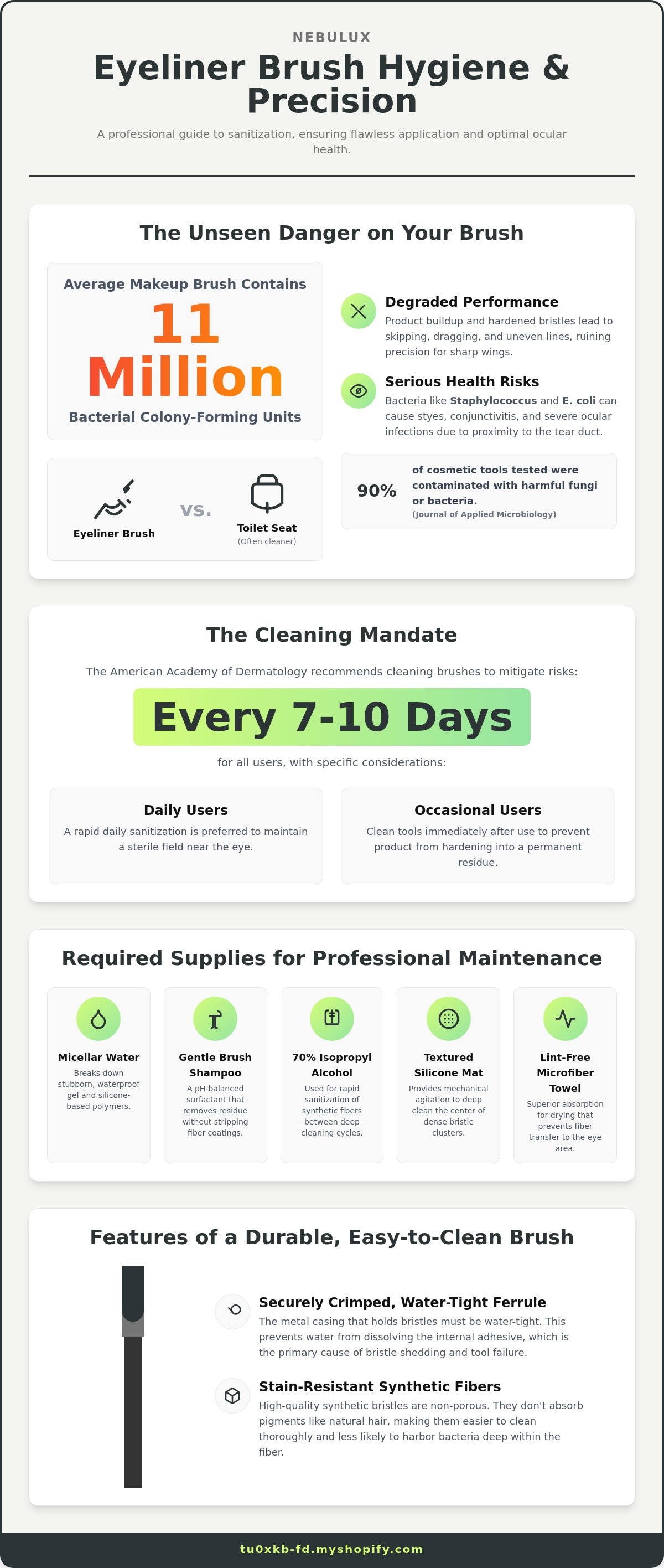
The proximity of eyeliner brushes to the tear duct makes hygiene non-negotiable. Every use transfers sebum, dead skin cells, and environmental pollutants into the brush head. Bacteria thrive in these dark, moist environments. A study by QS Supplies found that the average makeup brush contains nearly 11 million colony-forming units of bacteria. This contamination leads to styes, conjunctivitis, and severe ocular infections. It's a significant health risk that many users overlook until irritation occurs.
Synthetic fibers don't absorb product like natural hair. However, they still harbor pathogens within the dense bristle clusters. Staphylococcus aureus and E. coli are common contaminants found in unwashed tools. Research published in the Journal of Applied Microbiology revealed that up to 90% of tested cosmetic tools were contaminated with fungi or bacteria. The American Academy of Dermatology recommends a cleaning cycle every 7 to 10 days to mitigate these risks. For daily users, a rapid daily sanitization is preferred to maintain a sterile field near the eye. Occasional users should still clean tools immediately after use. This prevents product from hardening into a permanent residue. If you don't prioritize how to clean eyeliner brush equipment, you risk permanent ocular damage and rapid tool degradation.
Required Supplies for Professional Brush Maintenance
Effective maintenance begins with a functional inventory. You cannot achieve a surgically clean tool using generic hand soap or tap water alone. Understanding how to clean eyeliner brush equipment requires a kit designed for chemical and mechanical residue removal. Standardizing your supply list ensures tool longevity and consistent makeup precision. High-performance cleaning requires specific agents and tools to handle the dense pigments found in modern liners.
- Micellar water: Essential for breaking down stubborn, waterproof gel polymers before the deep wash.
- Gentle brush shampoo: A pH-balanced surfactant that removes residue without stripping fiber coatings.
- 70% Isopropyl alcohol: Used for rapid sanitization of synthetic fibers between deep cleaning cycles.
- Textured silicone mat: Provides mechanical agitation to reach the center of dense bristle clusters.
- Lint-free microfiber towel: Superior absorption that prevents fiber transfer to the eye area.
Choosing the Right Cleansing Agent
Synthetic fibers require specialized care. Unlike natural hair, synthetic eyeliner tools often carry heavy wax-based or silicone-based gels. These formulas bond tightly to the fibers. A standard mild soap often fails to dissolve these bonds. Micellar water or specialized oil-based cleansers are necessary to emulsify waterproof residues. Avoid harsh dish detergents or high-fragrance soaps. New FDA regulations expected in May 2026 will require clearer labeling of fragrance allergens, making it easier to select hypoallergenic, eye-safe cleansers. For those utilizing a professional Blade eyeliner brush, synthetic-safe cleansers are mandatory to preserve the sharp, tapered edge. Avoid chemicals that dissolve the adhesive within the ferrule, as this leads to permanent shedding.
Essential Tools for Deep Cleaning
Deep residue removal requires mechanical assistance. A textured silicone mat is more efficient than using your palm. These mats feature various surface patterns designed to dislodge dried product from the base of the bristles. This prevents the "clumping" effect that ruins fine-line application. Using your hand introduces skin oils and bacteria back into the tool, which is counterproductive to the sanitization process.
Drying is the final technical step. Use a lint-free microfiber towel for initial moisture removal. Standard paper towels leave behind microscopic debris that causes eye irritation. The American Academy of Dermatology recommends cleaning tools every 7 to 10 days to prevent bacterial colonies. After washing, position the tool on an angled surface or a dedicated drying rack. Gravity must pull moisture away from the ferrule. This prevents water ingress and protects the structural integrity of your eye makeup kit.
Step-by-Step Deep Cleaning for Gel and Liquid Residue
Precision application requires a tool free from microscopic debris. To begin the deep cleaning process, hold the brush under lukewarm water at a downward angle. Never submerge the entire tool. Water ingress into the ferrule dissolves the adhesive, leading to bristle shedding and handle rot. It's a common error in most maintenance routines. Once the bristles are saturated, apply a pea-sized amount of specialized cleanser to your palm or a textured mat. Understanding how to clean eyeliner brush sets correctly involves protecting the mechanical bond of the tool while removing chemical buildup.
Swirl the brush in gentle, circular motions. This mechanical action dislodges pigments from the core of the bristle head. For dense tools like a blade eyeliner brush, you might need to repeat this step to reach the innermost fibers. Rinse the tool thoroughly. The process is complete only when the water runs completely clear. A final rinse ensures no surfactants remain, which could otherwise cause chemical irritation to the eyelid during your next makeup application.
Complete the process with a rapid sanitization step. Dip only the tips of the bristles into 70% isopropyl alcohol for five seconds. Do not soak the entire brush head or the ferrule. Alcohol is an effective solvent, but it can damage the handle finish and the internal glue if overexposed. This step kills lingering bacteria, ensuring a sterile field for your next use. This method is far superior to simply wiping the tool on a tissue, which often leaves bacteria trapped deep within the bristles.
Removing Stubborn Waterproof Formulas
Waterproof gel liners contain long-wear polymers that resist standard soaps. Pre-treating these tools with micellar water or a cleansing oil is necessary. This step breaks the chemical bond before the deep wash. When maintaining a seal eyeliner pen or stamp, focus on the crevices of the applicator. Use your thumb and forefinger to gently massage the cleanser into the fibers. This ensures the core is free from dried product that causes stamp distortion and uneven wing symmetry.
Rinsing and Temperature Control
Temperature management is critical for synthetic fiber longevity. Use lukewarm water exclusively. Hot water damages the "memory" of synthetic bristles, causing them to flare or lose their tapered edge. This permanent deformation makes sharp wings impossible to execute. During the final rinse, squeeze the bristles gently under the stream. If any cloudiness appears, pigment remains trapped. Continue rinsing until the water is transparent. Residual soap acts as a magnet for dust and bacteria, which compromises both tool performance and ocular health.
Post-Wash Care: Drying and Bristle Realignment
Effective maintenance doesn't end with the rinse. Residual moisture is the primary cause of tool failure. Learning how to clean eyeliner brush tools correctly includes a strict post-wash protocol to prevent structural decay. After the final rinse, use a lint-free microfiber towel to absorb excess water. Gently squeeze the bristles. Never pull or tug on the fibers. This mechanical stress weakens the bond between the bristles and the ferrule, leading to premature shedding. A microfiber towel is preferred over paper alternatives as it leaves no lint behind to interfere with your next application.
Protecting the Brush Ferrule
The ferrule is the metal sleeve connecting the handle to the bristles. It houses the adhesive that secures the fiber bundle. Drying brushes upright in a cup is a common error that leads to rapid tool degradation. This orientation allows gravity to pull water into the ferrule through capillary action. Trapped moisture dissolves the glue and causes wooden handles to swell and paint to chip. To prevent this, lay brushes flat on a clean towel. For optimal results, use the downward tilt method. Prop the handle up slightly so the brush head sits lower than the ferrule. This ensures any remaining water drains away from the adhesive bond and the handle core.
Restoring the Precision Edge
Precision tools require manual realignment while damp. Use your thumb and forefinger to pinch the bristles back into a sharp, tapered blade or fine point. This resets the synthetic fiber memory. If left to dry in a splayed state, the brush will lose its ability to create crisp wings. Ensure no stray hairs are bent or crossed. Synthetic eyeliner tools typically require 4 to 8 hours to dry completely, depending on ambient humidity. Never use hair dryers or direct sunlight. High heat melts synthetic fibers and compromises the glue's integrity. For professional results, maintain your kit with a Blade eyeliner brush designed for durability and easy reshaping.
Wait until the bristles are completely dry to the touch before returning them to a closed storage container. Storing damp brushes encourages the growth of the 11 million colony-forming units of bacteria mentioned earlier. A dry, well-ventilated environment is essential for maintaining a sterile makeup kit. Consistency in this post-wash routine ensures your tools remain sharp, hygienic, and functional for years rather than months.
Features of Easy-to-Clean Eyeliner Brushes
Tool selection directly dictates maintenance efficiency. A high-performance kit requires instruments designed for chemical resistance and structural longevity. When evaluating how to clean eyeliner brush inventory, prioritize materials that repel rather than absorb pigments. High-density synthetic fibers, non-porous surfaces, and chemical-resistant coatings define the professional standard. These features ensure pigments remain on the surface. This allows for rapid sanitation without damaging the tool's core integrity.
Durability is a functional requirement. Securely crimped, double-threaded ferrules prevent water ingress. This is a primary cause of handle rot and adhesive failure. Ergonomic handles, often constructed from treated wood or high-grade polymers, must withstand frequent exposure to surfactants and isopropyl alcohol. A precision tool is a "skinvestment" in 2026. Consumers now favor high-quality, long-lasting instruments over disposable alternatives. This shift aligns with broader industry moves toward sustainability and safety in cosmetic tool manufacturing.
Synthetic vs. Natural Bristles
Synthetic fibers are the superior choice for liquid, gel, and cream formulas. Modern materials like Taklon are non-porous and hypoallergenic. They don't possess the cuticle scales found in natural hair. Those scales trap bacteria and old pigment, making deep cleaning difficult. This structural difference makes the process of how to clean eyeliner brush tools significantly faster. Professional-grade synthetic tools resist staining from heavy carbon black or iron oxide pigments. They maintain their "snap" and shape even after hundreds of wash cycles. Natural bristles become brittle and splayed when exposed to the deep cleansers required to dissolve waterproof liners.
Selecting Your Next Precision Tool
The Nebulux Blade eyeliner brush represents the pinnacle of precision engineering. Its ultra-thin profile is designed for sharp wings and tight-lining. The flat shape makes it exceptionally easy to clean. Unlike round brushes with dense centers, the blade design allows cleansers to penetrate the entire fiber bundle instantly. This reduces the mechanical stress required during the wash cycle. It ensures a faster turnaround time for daily users who require surgically clean tools every morning.
When comparing flat vs. angled eyeliner brushes, consider the drying process. Flat blades often reset their shape more reliably than angled versions. Angled brushes may flare at the longest point over time if not realigned perfectly after every wash. Investing in tools with high fiber memory ensures your precision edge remains intact. For those using a stamp system, look for silicone-based applicators that offer a touch-free alternative to traditional bristles. These tools align with the 2026 trend toward enhanced hygiene and contactless application. They ensure your makeup routine remains efficient, sterile, and professional.
Optimize Your Precision Beauty Routine
Maintaining a sterile makeup kit is a functional necessity for both ocular health and application accuracy. Consistent hygiene prevents the accumulation of bacteria. It eliminates the 11 million colony-forming units typically found on unwashed tools. Proper drying techniques, such as the downward tilt method, protect your investment from structural rot and handle swelling. By mastering how to clean eyeliner brush equipment, you ensure every wing is executed with a surgically clean edge.
Professional results require high-performance instruments that withstand frequent sanitation cycles. Shop the Nebulux Blade Eyeliner Brush for professional results. This tool utilizes professional-grade synthetic bristles optimized for gel and liquid formulas. It is specifically designed for long-term durability. It maintains its precise blade shape after every wash. Upgrade your inventory to experience consistent pigment distribution and superior tool longevity. Start your next application with a sterile field for a flawless, irritation-free finish.
Frequently Asked Questions
How often should I clean my eyeliner brush?
Clean your tools every 7 to 10 days to meet professional hygiene standards. Daily users should perform a rapid spot clean after every application to prevent gel formulas from hardening. This frequency ensures the bristles maintain the flexibility and sharp edge required for precision wing execution. Regular maintenance prevents the accumulation of skin oils and environmental pollutants.
Can I use olive oil to clean my eyeliner brushes?
Avoid using olive oil as a primary cleanser. While oils break down waterproof pigments, kitchen oils leave a heavy residue that is difficult to strip from synthetic fibers. This film attracts bacteria and prevents fresh makeup from adhering to the bristles. Use micellar water or a specialized cosmetic cleansing oil designed for rapid emulsification and clean rinsing.
What happens if I don’t clean my eyeliner brush?
Neglecting maintenance leads to tool degradation and ocular health risks. Dried product causes bristles to splay, which destroys the fine point needed for sharp lines. Contaminated fibers harbor pathogens that cause styes and infections. You'll also experience muddy color payoff as old, oxidized residue mixes with your fresh eyeliner pigments.
Is it okay to use a hair dryer to speed up drying?
Do not use hair dryers or direct heat sources. High temperatures melt synthetic fiber memory and dissolve the adhesive within the ferrule. This results in permanent bristle deformation and excessive shedding. Allow your tools to air dry naturally on a flat surface or at a downward angle for 4 to 8 hours to ensure structural integrity.
Does isopropyl alcohol damage synthetic brush bristles?
70% isopropyl alcohol is safe for synthetic fibers when used for quick sanitization dips. It provides an effective microbial kill without damaging the fiber matrix. Don't soak the ferrule or handle in alcohol, as the solvent can degrade the internal glue and exterior finish. This is a critical step for how to clean eyeliner brush tools used in high-frequency environments.
How do I know when it is time to replace my eyeliner brush?
Replace your tool when the bristles no longer return to a sharp blade or fine point after washing. Permanent splaying, persistent shedding, or a loose ferrule indicate the tool has reached the end of its functional life. High-performance synthetic tools typically require replacement every 6 to 12 months depending on use and maintenance consistency.
Can I use baby shampoo for cleaning makeup tools?
Baby shampoo is an effective, gentle surfactant for removing powder and water-based residues. It cleans without stripping specialized fiber coatings. For stubborn gel or waterproof liners, combine the shampoo with a textured mat or pre-treat the bristles with micellar water. This ensures all long-wear polymers are fully emulsified and removed from the fiber core.
How do I get dried gel liner out of the base of the bristles?
Use a textured silicone mat to provide the necessary mechanical agitation. Apply an oil-based cleanser directly to the buildup and massage it into the fibers with your thumb. This is the most effective technique for how to clean eyeliner brush sets with deep-seated residue. Rinse with lukewarm water until the core is transparent and the water runs clear.